

Explore the latest books of this year!
Bookbot

Modern European Philosophy

This series delves into the core of European philosophy, exploring prominent thinkers, concepts, and schools of thought from the Kantian and post-Kantian traditions. It offers both introductory overviews and specialized analyses, encouraging a broad interpretation of the modern European intellectual landscape. The collection champions a philosophical rather than purely historical approach to its subjects. Readers will find a rich engagement with ideas that have shaped modern thought.

The philosophy and politics of Bruno Bauer
Hegel and Modern Society
Hegel, Nietzsche, and philosophy
Foucault and classical antiquity
Kant's Theory of Taste
Kierkegaard's relations to Hegel reconsidered
  • Jon Stewart's groundbreaking study is a major re-evaluation of the complex relationship between the philosophies of Kierkegaard and Hegel. Although the standard view on the subject is that Kierkegaard defined himself as explicitly anti-Hegelian (and viewed Hegel's philosophy with disdain), Jon Stewart demonstrates that Kierkegaard's criticism was not directed specifically to Hegel, but actually to some contemporary Danish Hegelians.

    Kierkegaard's relations to Hegel reconsidered
    4.0
  • Kant's Theory of Taste

    A Reading of the Critique of Aesthetic Judgment

    • 444 pages
    • 16 hours of reading

    This scholarly work delves into Kant's aesthetics, offering a critical analysis by a prominent expert in the field. It explores Kant's theories on beauty, art, and the nature of aesthetic experience, providing insights into his philosophical framework. The study aims to enhance understanding of Kant's influence on contemporary aesthetic thought and the implications of his ideas for modern philosophy.

    Kant's Theory of Taste
    4.4
  • This 2005 book is a critical examination of Michel Foucault's relation to ancient Greek thought, in particular his famous analysis of Greek history of sexuality. Wolfgang Detel offers an understanding of Foucault's theories of power and knowledge based on modern analytical theories of science and concepts of power. He offers a complex reading of the texts which Foucault discusses, covering topics such as Aristotle's ethics and theory of sex, Hippocratic dietetics, the earliest treatises on economics, and Plato's theory of love. The result is a philosophically rich and probing critique of Foucault's later writings, and a persuasive account of the relation between ethics, power and knowledge in classical antiquity. His book will have a wide appeal to readers interested in Foucault and in Greek thought and culture.
    Foucault and classical antiquity
  • This study explores the theme of freedom in the philosophy of Hegel and Nietzsche. First, Will Dudley sets Hegel's Philosophy of Right within a larger systematic account and deploys the Logic to interpret it. He demonstrates that freedom involves not only the establishment of certain social and political institutions but also the practice of philosophy itself. Then, he reveals how Nietzsche's discussions of decadence, nobility and tragedy lead to an analysis of freedom that critiques heteronomous choice and Kantian autonomy, and ultimately issues a positive conception of liberation.

    Hegel, Nietzsche, and philosophy
    4.6
  • This is the first comprehensive study in English of Bruno Bauer, a leading philosopher of the 1840s. Inspired by the philosophy of Hegel, Bauer led an intellectual revolution that influenced Marx and shaped modern secular humanism. In the process he offered a republican alternative to liberalism and socialism, criticized religious and political conservatism and set out the terms for the development of modern mass and industrial society.

    The philosophy and politics of Bruno Bauer
    4.5
  • The philosophy of Hans-Georg Gadamer interests a wide audience that spans the traditional distinction between European (continental) and Anglo-American (analytic) philosophy. Yet one of the most important and complex aspects of his work - his engagement with German Idealism - has received comparatively little attention. In this book, Kristin Gjesdal uses a close analysis and critical investigation of Gadamer's Truth and Method (1960) to show that his engagement with Kant, Hegel, and Schleiermacher is integral to his conception of hermeneutics. She argues that a failure to engage with this aspect of Gadamer's philosophy leads to a misunderstanding of the most pressing problem of post-Heideggerian hermeneutics: the tension between the commitment to the self-criticism of reason, on the one hand, and the turn towards the meaning-constituting authority of tradition, on the other. Her study provides an illuminating assessment of both the merits and the limitations of Gadamer's thought.

    Gadamer and the legacy of German idealism
  • Heidegger's Analytic

    Interpretation, Discourse and Authenticity in Being and Time

    • 340 pages
    • 12 hours of reading

    Unlike those who view Heidegger as an idealist, Taylor Carman asserts that Heidegger is best understood as a realist and offers a new interpretation of his major work, Being and Time. Among the book's distinctive features are an interpretation explicitly oriented within a Kantian framework (often taken for granted in readings of Heidegger) and an analysis of Dasein in relation to recent theories of intentionality; notably those of Dennett and Searle.

    Heidegger's Analytic
    3.7
  • This major study of Kant provides a detailed examination of the development and function of the doctrine of transcendental illusion in his theoretical philosophy. The author argues that we cannot understand Kant unless we take seriously his claim that the mind inevitably acts in accordance with ideas and principles that are "illusory." Taking this claim seriously, we can make much better sense of Kant's arguments and reach a deeper understanding of the role he allots human reason in science.

    Kant's doctrine of transcendental illusion
    4.6
  • Exploring the intersection of music and philosophy, Andrew Bowie challenges the notion that philosophy should solely provide answers about music. He examines influential philosophical perspectives on music from Kant to Adorno, arguing that music can illuminate critical philosophical questions regarding language, subjectivity, and ethics. By revealing the limitations of contemporary philosophical views on communication and meaning, Bowie positions music as a vital resource for philosophical inquiry, appealing to both philosophers and musicologists alike.

    Music, Philosophy, and Modernity
    3.9
  • This is a major new study of Kant's ethics that will transform the way students and scholars approach the subject in the future. Allen Wood argues that Kant's ethical vision is grounded in the idea of the dignity of the rational nature of every human being. He focuses for the first time on the central role played in Kant's ethical theory by the value of rational nature as an end in itself. In addition, he shows the importance of Kant's systematic theory of human nature and history, and its implications for the structure, formulation, and application of Kant's moral principles.

    Kants' ethical thought
    4.1
  • The Morals of Modernity

    • 240 pages
    • 9 hours of reading

    The essays delve into the intricate relationship between moral philosophy and modernity, focusing on how contemporary experiences shape moral reasoning. They critically assess whether prevailing modern philosophical perspectives overlook significant aspects of moral existence, prompting a reevaluation of ethical frameworks in light of modern challenges.

    The Morals of Modernity
    3.7
  • This is the first book-length treatment of the unique nature and development of Nietzsche's post-Zarathustran political philosophy. This later political philosophy is set in the context of the critique of modernity that Nietzsche advances in the years 1885-1888, in such texts as Beyond Good and Evil, On the Genealogy of Morals, Twilight of the Idols, The Antichrist, The Case of Wagner, and Ecce Homo. Daniel Conway has written a powerful book about Nietzsche's own appreciation of the limitations of both his writing style and of his famous prophetic "stance".

    Nietzsche's dangerous game
    4.0
  • This book offers a fundamentally new account of the arguments and concepts which define Heidegger's early philosophy, and locates them in relation to both contemporary analytic philosophy and the history of philosophy. Drawing on recent work in the philosophy of mind and on Heidegger's lectures on Plato and Kant, Sacha Golob argues against existing treatments of Heidegger on intentionality and suggests that Heidegger endorses a unique position with respect to conceptual and representational content; he also examines the implications of this for Heidegger's views on truth, realism and 'being'. He goes on to explore Heidegger's work on the underlying issue of normativity, and focuses on his theory of freedom, arguing that it is freedom that links the existential concerns of Being and Time to concepts such as reason, perfection and obligation. His book offers a distinctive new perspective for students of Heidegger and the history of twentieth-century philosophy.

    Heidegger on concepts, freedom and normativity
    4.0
  • In this first in-depth critical appraisal in English of the writings of Carl Schmitt, John McCormick has furnished philosophers, historians, and political theorists with the most comprehensive account of Schmitt's critique of liberalism available. He examines why technology becomes a rallying cry for both right- and left-wing intellectuals at times when liberalism appears anachronistic, and shows the continuities between Weimar's ideological debates and those of our own age.

    Carl Schmitt's critique of liberalism
    3.7
  • Dieses Buch ist eine umfassende Studie über das Werk von Bruno Bauer im Vormärz. Inspiriert durch Hegels Philosophie führte Bauer eine intellektuelle Revolution an, die Marx beeinflußte und den modernen säkularen Humanismus formte. Bauer bot eine republikanische Alternative zum Liberalismus und Sozialismus an, kritisierte den religiösen und politischen Konservatismus und erforschte die Entstehung der modernen Massengesellschaft. Ebenso befaßt sich dieses Buch auf der Basis intensiver Archivforschung mit den problematischen Aspekten von Bauers Kritik an der Modernität und vor allem mit seinem Antisemitismus.

    Philosophie und Politik bei Bruno Bauer
  • Das theologisch-politische Problem

    Zum Thema von Leo Strauss

    • 72 pages
    • 3 hours of reading

    Nichts ist so umstritten im Denken von Leo Strauss und nichts ist so zentral für sein Verständnis wie das theologisch-politische Problem. Da es im Zentrum von Strauss' Politischer Philosophie steht, findet der Streit seinen Niederschlag in allen großen Kontroversen, die sein uvre umgeben. Heinrich Meiers theologisch-politisches Traktat ist die erste Schrift zu Strauss, die das Problem, von dem Strauss sagte, es sei das Thema seiner Untersuchungen gewesen, zu ihrem Thema macht. Neben dem programmatischen Vortrag „Das theologisch-politische Problem“, der auf dem internationalen Leo Strauss Symposium in München im Juni 2002 große Beachtung fand, enthält sie den Kommentar „Zur Genealogie des Offenbarungsglaubens“, der eine kühne genealogische Skizze von Strauss aus dem Nachlass zugänglich macht und argumentativ entfaltet, sowie den Text „Der Tod als Gott. Eine Anmerkung zu Martin Heidegger“, der den Blick auf einen Philosophen richtet, auf dessen Denken das theologisch-politische Problem seinen langen Schatten geworfen hat, ohne dass es bei ihm jemals ein Thema von Gewicht war.

    Das theologisch-politische Problem
    3.0
  • Anne Margaret Baxley offers a systematic interpretation of Kant's theory of virtue, whose most distinctive features have not been properly understood. She explores the rich moral psychology in Kant's later and less widely read works on ethics, and argues that the key to understanding his account of virtue is the concept of autocracy, a form of moral self-government in which reason rules over sensibility. Although certain aspects of Kant's theory bear comparison to more familiar Aristotelian claims about virtue, Baxley contends that its most important aspects combine to produce something different - a distinctively modern, egalitarian conception of virtue which is an important and overlooked alternative to the more traditional Greek views which have dominated contemporary virtue ethics.

    Kant's theory of virtue
    4.0
  • This 2007 book examines the possibilities for the rehabilitation of Hegelian thought within analytic philosophy. From its inception, the analytic tradition has in general accepted Bertrand Russell's hostile dismissal of the idealists, based on the claim that their metaphysical views were irretrievably corrupted by the faulty logic that informed them. These assumptions are challenged by the work of such analytic philosophers as John McDowell and Robert Brandom, who, while contributing to core areas of the analytic movement, nevertheless have found in Hegel sophisticated ideas that are able to address problems which still haunt the analytic tradition after a hundred years. Paul Redding traces the consequences of the displacement of the logic presupposed by Kant and Hegel by modern post-Fregean logic, and examines the developments within twentieth-century analytic philosophy which have made possible an analytic re-engagement with a previously dismissed philosophical tradition.

    Analytic philosophy and the return of Hegelian thought
    4.3
  • This book, by one of the most prominent interpreters of Leo Strauss's thought, is the first to examine the theme that Leo Strauss considered to be key to his entire intellectual enterprise. The theologico-political problem refers to the confrontation between the theological and the political alternative to philosophy as a way of life. In this study, Heinrich Meier clarifies the distinction between political theology and political philosophy and sheds new light on the unifying center of Strauss' philosophical work. The book is the culmination of his work on the general topic of the theologico-political problem.

    Leo Strauss and the theologico-political problem
    4.3
  • Hegel's concept of action

    • 216 pages
    • 8 hours of reading

    Michael Quante focuses on what Hegel has to say about such central concepts as action, person and will, and then brings these views to bear on contemporary debates in analytic philosophy. This book enables professional analytic philosophers and their students to understand the significance of Hegel's philosophy to contemporary theory of action. As such, it will contribute to the ever-increasing erosion of the barrier between the continental and analytic approaches to philosophy.

    Hegel's concept of action
    4.5
  • Hegel's phenomenology of spirit

    • 330 pages
    • 12 hours of reading

    This is a new interpretative guide to Hegel's influential Phenomenology of Spirit, a work that combines a world history of culture and society with a systematic epistemology and a philosophy of nature and culture. A subtle and elegantly argued assessment, the book appears here in English for the first time.

    Hegel's phenomenology of spirit
    4.0
  • Kant and the Fate of Autonomy

    Problems in the Appropriation of the Critical Philosophy

    • 366 pages
    • 13 hours of reading

    Challenging popular notions of freedom, the author explores the underlying assumptions that shape contemporary understanding of the concept. By critically examining these ideas, the work invites readers to reconsider what freedom truly means and how it can be interpreted in various contexts. Through insightful analysis, the book aims to deepen the discussion around individual liberty and its implications in society.

    Kant and the Fate of Autonomy
    4.0
  • Idealism as Modernism

    Hegelian Variations

    • 484 pages
    • 17 hours of reading

    The book challenges conventional views on modern philosophy by emphasizing concepts of agency, freedom, and ethical life rooted in the German idealist tradition, particularly Hegel's writings. Robert Pippin critically examines Hegel's perspectives and then broadens the discussion to include interpretations from Habermas, Strauss, Blumenberg, Nietzsche, and Heidegger, offering a comprehensive analysis of modernity through these philosophical lenses.

    Idealism as Modernism
    3.7
  • Hegels Begriff der Handlung

    • 262 pages
    • 10 hours of reading

    The concept of action is one of the key concepts of practical philosophy. This work examines the core of Hegel‹s concept of action, §§ 105-125 of the ‹Grundlinien‹ (Elements of the Philosophy of Right) and their references to the ‹Wissenschaft der Logik‹ (Science of Logic). The author describes and interprets the systematic content of Hegel‹s concept of action against the backdrop of the current speech act theory. The continuing relevance of the book is shown in its current translations, for example into Italian, Japanese, Spanish and Hungarian.

    Hegels Begriff der Handlung
  • Foucault on Freedom

    • 240 pages
    • 9 hours of reading

    The book explores various interpretations of freedom within Foucault's philosophy, focusing on three key divisions. It delves into how these interpretations shape our understanding of autonomy, power, and social structures, offering a nuanced analysis of Foucault's ideas and their implications for contemporary thought. Through this examination, the author sheds light on the complexities of freedom and its relevance in philosophical discourse.

    Foucault on Freedom
    4.0
  • Kant's moral philosophy is explored through the lens of the inherent conflict between happiness and morality, emphasizing how this tension arises from common human experiences. The book delves into the implications of these conflicts, revealing how they shape our understanding of ethical behavior and the pursuit of a meaningful life. By examining these themes, the author provides a fresh perspective on Kant's ideas and their relevance to contemporary moral dilemmas.

    Kant's Defense of Common Moral Experience
  • Die Verwirklichung der Freiheit

    Der Idealismus als Diskurs der Moderne

    Das Schlüsselproblem der modernen deutschen Philosophie betrifft die zentrale Verheißung der europäischen Moderne selbst: die Möglichkeit eines freien, ja sogar autonomen Lebens. Pippin problematisiert verschiedene gängige Charakterisierungen dieser Denktradition. Dabei präsentiert er eine originelle Interpretation der anspruchsvollsten Begründungen dieser Verheißung im Werke Kants und Hegels und verteidigt zugleich deren Freiheitsbegriff in einem Vergleich mit konkurrierenden Vorstellungen, insbesondere denen von Nietzsche, Heidegger, Leo Strauss, Blumenberg und Habermas.

    Die Verwirklichung der Freiheit
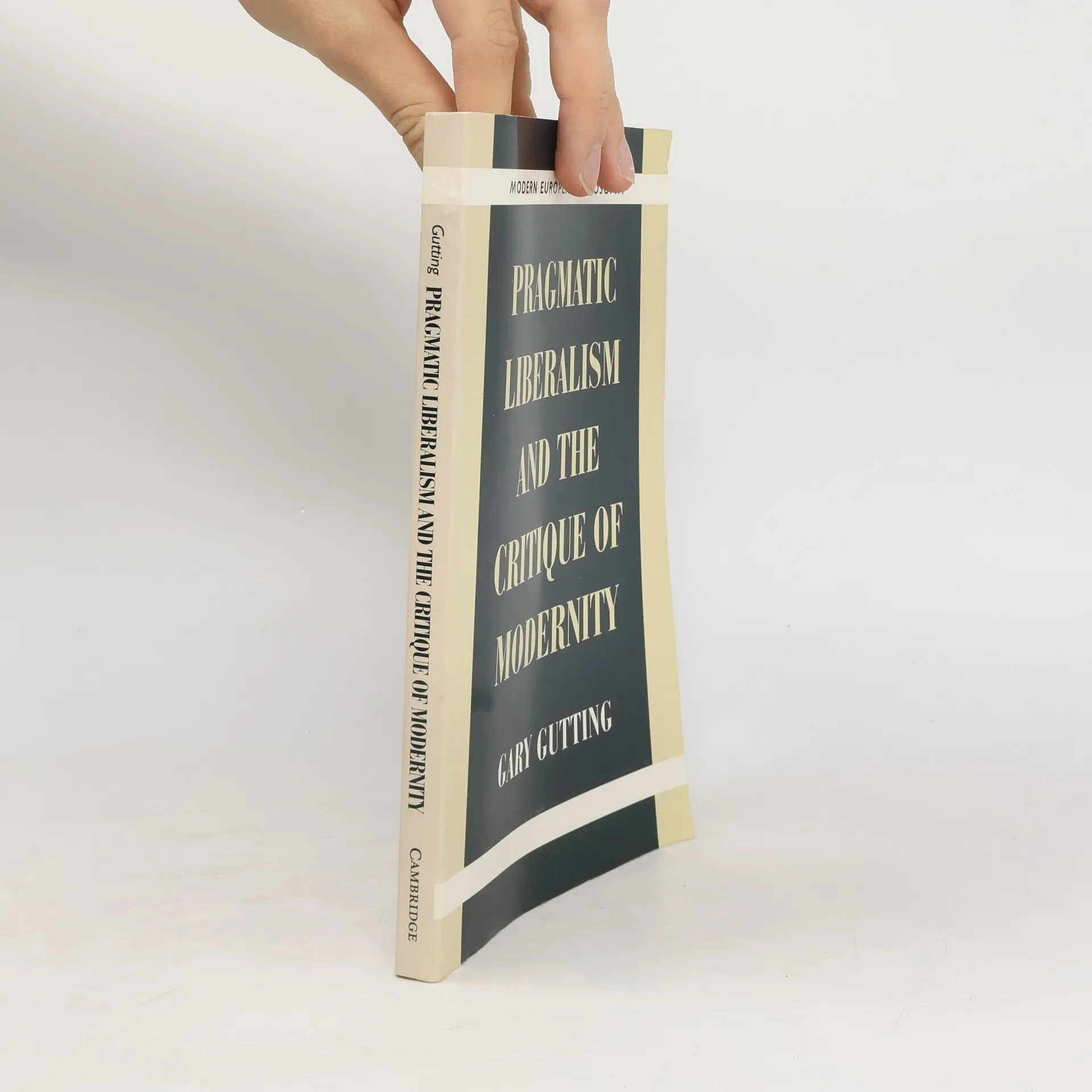
  • In this book Gary Gutting offers a powerful account of the nature of human reason in modern times. The fundamental question addressed by the book is what authority human reason can still claim once it is acknowledged that our fundamental metaphysical and religious pictures of the world no longer command allegiance. Gutting analyzes the work of three dominant philosophical voices in our Richard Rorty, Alasdair MacIntyre, and Charles Taylor. His own position is defined as "pragmatic liberalism." The book will appeal to readers in such fields as philosophy, literature, and political theory. The interpretations of Rorty, MacIntyre, and Taylor will make the book suitable as a coursebook for those teaching the history of modern philosophy.

    Pragmatic Liberalism and the Critique of Modernity
    4.2